

![[sort:pic]](/template/default/images/banner/3-3.jpg)
Lean management provides customers with high-quality services and a visible panoramic view of the prosperous era.
Share
Urgent Update: Trump Expands Tariff Coverage — Effective September 8
Overview
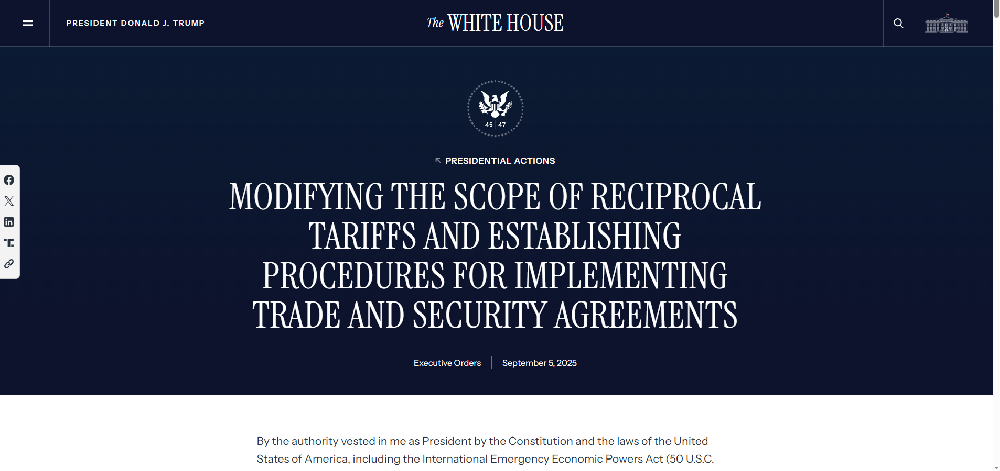
On September 5, 2025 (U.S. time), President Donald Trump signed an executive order modifying the scope of U.S. import tariffs and implementing newly negotiated Trade and Security Framework Agreements with foreign partners.
Policy Background
On April 2, 2025, the Trump administration introduced the first “Reciprocal Tariffs,” citing large and persistent trade deficits as a national security and economic emergency.
On September 5, 2025, the administration expanded and adjusted the tariff scope to align with the new Trade and Security Framework Agreements.
Key Provisions of the Executive Order
Once a framework or final trade agreement is reached with a foreign partner, the United States may adjust tariff rates based on the terms of that agreement. Adjustments may include reducing reciprocal tariffs on certain products to zero.
However, before a final agreement is signed, the U.S. will generally not narrow tariff coverage nor modify existing Section 232 tariffs (steel and aluminum derivatives).
Adjustments in Tariff Coverage
These countries may apply most-favored-nation (MFN) tariff rates to affected products.
These include goods that cannot be produced in the U.S. or are produced in insufficient quantities to meet domestic needs:
- Aircraft and aircraft parts
- Generic pharmaceuticals and active ingredients
- Natural resources and derivatives that the U.S. lacks sufficient supply of
- Agricultural products with inadequate U.S. production
Newly Granted Exemptions (Not Subject to Reciprocal Tariffs)
- Gold and gold-related products
- Certain critical minerals
- Pharmaceutical products currently under Section 232 investigation
Newly Added Products Subject to Tariffs
- Certain aluminum hydroxide products
- Specific types of resins
- Silicon-based products

Effective Date
12:01 a.m. ET, September 8, 2025
The revised tariff measures officially take effect.
International Media Reaction
Reuters:
According to Reuters, the new policy allows certain products—such as nickel, gold, graphite, chemicals, EV components, and medical device parts—to be exempt from steep reciprocal tariffs if a reciprocal agreement is in place, making them eligible for low or zero tariff rates.
Analysts view this as a continuation of Trump’s strategy of using tariffs as a negotiating tool to pressure foreign governments into making concessions on trade and security.
In a fast-changing tariff landscape and increasingly unpredictable supply chain environment, having a reliable partner is critical.
As a service provider offering both customs clearance and trucking, we bring over 50 years of clearance experience and a fully self-operated professional Chinese-American customs team.
We specialize in U.S. last-mile customs clearance and transfer services, Amazon FBA logistics, and one-stop 3PL warehousing solutions — headquartered in Los Angeles.

In this challenging tariff environment, choosing SS Group means choosing professionalism, efficiency, and peace of mind.
We stand ready to safeguard your cargo with expert capability and help your business navigate today’s turbulent global trade market — moving forward steadily and expanding into even greater opportunities.
If you need assistance, feel free to reach out to us anytime.
 Message Consultation