
![[sort:pic]](/template/default/images/banner/3-3.jpg)
Lean management provides customers with high-quality services and a visible panoramic view of the prosperous era.
Share
🇺🇸🇨🇳 Busan Summit Breakthrough: Fentanyl Tariff Cut to 10%, U.S. Suspends 50% Ownership Rule, Both Sides Pause Port Fees
Overview
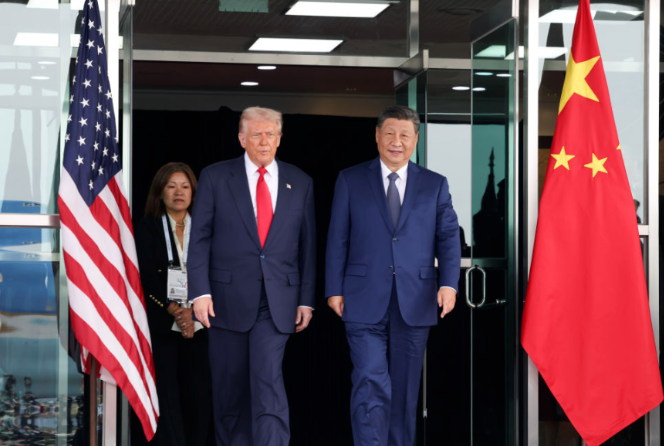
On October 30 (local time), the top leaders of China and the United States met in Busan, South Korea.
Three hours after the meeting concluded, the joint outcome of the China–U.S. Kuala Lumpur economic consultations was released, delivering three major results:
1.The U.S. will reduce the Fentanyl Tariff to 10%.
2.The U.S. will suspend the 50% ownership “penetration rule,” while China will suspend its rare-earth controls.
3.China and the U.S. will mutually suspend port fees.
In addition, both sides reached consensus on cooperation in fentanyl-related law enforcement, expanding agricultural trade, and addressing specific corporate cases.

Outcome 1: Fentanyl Tariff Reduced to 10%
Since returning to office earlier this year, President Trump had raised the Fentanyl Tariff to 20%, claiming that fentanyl originating from China posed a threat to the United States.
During the October 30 Kuala Lumpur consultations, the U.S. agreed to remove 10 percentage points of the Fentanyl Tariff imposed on Chinese goods (including Hong Kong and Macau).
Important:
It was 20% → the U.S. is removing 10% → effective tariff becomes 10%.
Additionally, the 24% reciprocal tariff imposed on Chinese goods (including Hong Kong and Macau) will remain suspended for one year.
| Stage | Tariff Components |
|---|---|
| Before meeting | 10% Reciprocal Tariff + 20% Fentanyl Tariff + MFN |
| After meeting | 10% Reciprocal Tariff + 10% Fentanyl Tariff + MFN |
Products still falling under Section 301 or Section 232 will continue to pay those duties in addition to the above.
Outcome 2: U.S. Suspends the 50% Ownership “Penetration Rule”
On September 29, a Federal Register notice introduced what industry analysts call the 50% Penetration Rule—a potentially devastating measure against China’s semiconductor supply chain.
What the rule means
Previously:
- If Company A was on the U.S. Entity List, it could not purchase U.S. chips, software, or technology.
- BUT its subsidiary “A-Sub,” which is not listed, could still buy those items.
With the new rule:
- If Company A holds 50% or more ownership in any subsidiary,
- ALL subsidiaries are treated as restricted.
- They cannot purchase U.S. technology, even if not explicitly listed.
Effect:In exchange for China suspending its rare-earth export controls, the U.S. agreed to:
✔ Suspend the 50% Penetration Rule for one year
✔ China will suspend rare-earth controls for one year and develop a more detailed regulatory framework
This outcome is widely seen as one of China’s biggest strategic wins in the meeting.
Outcome 3: China & U.S. Mutually Suspend Port Fees
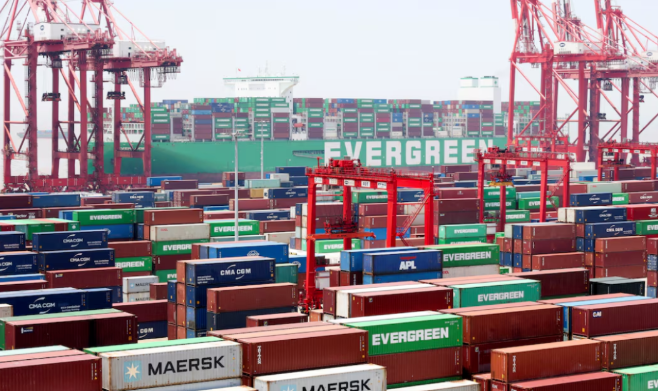
Earlier this year, the Trump administration planned to impose fees on ships tied to China as part of its effort to reduce Chinese influence in global shipping and boost U.S. shipbuilding.
These fees had:
- Cost carriers—including state-owned COSCO and U.S. carrier Matson—millions of dollars
- Disrupted shipping schedules
- Increased freight costs
- Led experts to warn that higher prices would ultimately hit consumers
The U.S. had also imposed 100% tariffs on Chinese-made port cranes.
During the Busan consultations:
✔ The U.S. agreed to suspend its 301 maritime, logistics, and shipbuilding measures targeting China for one year
✔ China agreed to suspend its countermeasures and fees on U.S.-related vessels
According to the Chinese Ministry of Commerce, the suspension applies to all 301 penalties involving China's maritime, logistics, and shipbuilding industries.
Western Media Reaction
- Falls short of a major agreement, unlike the “Phase One deal” from Trump’s first term
- But offers negotiators on both sides a valuable “breathing space”
- Symbolic stabilization of bilateral relations
- Effective use of rare-earth leverage
- Relief for the semiconductor sector
- Trump secures political credit with American farmers
- Reduced supply chain disruption for U.S. multinationals
The temporary agreement does avoid immediate escalation—but not future escalation.
Both sides want greater stability but cannot afford overly optimistic expectations of each other.
Your Trusted Partner in a Rapidly Changing Tariff Landscape
In today’s environment—where tariff policies shift quickly and supply chain uncertainty grows—a reliable, professional logistics partner is critical.With over 50 years of U.S. customs clearance experience and a self-operated team of green-card-holding Chinese-American brokers, SS Group specializes in:
- U.S. end-to-end customs clearance & trucking
- Amazon FBA logistics
- One-stop 3PL warehousing
Headquartered in Los Angeles, we ensure professional, efficient, and secure handling of your cargo—helping your business move confidently through a volatile global trade environment.
If you need assistance, feel free to contact us anytime.
 Message Consultation